|
|
|
|
INSTITUTIONAL REPOSITORIES IN KARNATAKA UNIVERSITIES: STATUS ASSESSMENT, AI-ASSISTED FRAMEWORK DEVELOPMENT AND FUTURE RESEARCH DIRECTIONS
Dr. Gouri Gourikeremath
1 , Dr. Rudramuni Hiremath 2

1 Chief
Librarian, Department of Library and Information Centre Anjuman Arts, Science
and Commerce College & P.G. Studies, Dharwad, Karnataka, India
2 Librarian,
Department of Library and Information Centre Shri Shankar Arts &, Commerce
College, Navalgund, Karnataka, India
|
|
|
ABSTRACT |
|
|
Digital
repositories have become essential components of modern academic
infrastructure, serving as platforms for knowledge preservation,
dissemination, and accessibility. This theoretical research examines
institutional repositories within Karnataka's higher education landscape,
analyzing current implementation patterns, identifying systemic challenges,
and proposing an artificial intelligence-enhanced framework to address
existing limitations. The investigation employs comprehensive literature
analysis and theoretical modeling to understand repository development across
diverse institutional types. Findings reveal substantial disparities in
adoption maturity, content population rates, faculty engagement levels, and
technological sophistication among Karnataka universities. This study
contributes a conceptual framework integrating machine learning algorithms,
natural language processing capabilities, automated content management
systems, and predictive analytics to enhance repository functionality. Seven
critical research gaps are identified encompassing coordination mechanisms,
technology integration strategies, stakeholder participation dynamics,
sustainability architectures, multilingual content management, policy
development, and user behavior patterns. The proposed theoretical framework
offers a foundation for future empirical investigations and practical
implementations, potentially serving as a reference model for regional
repository development initiatives. |
|||
|
Received 08 April 2025 Accepted 17 May 2025 Published 30 June 2025 Corresponding Author Dr. Gouri
Gourikeremath, nggouri@gmail.com DOI 10.29121/ShodhAI.v2.i1.2025.48 Funding: This research
received no specific grant from any funding agency in the public, commercial,
or not-for-profit sectors. Copyright: © 2025 The
Author(s). This work is licensed under a Creative Commons
Attribution 4.0 International License. With the
license CC-BY, authors retain the copyright, allowing anyone to download,
reuse, re-print, modify, distribute, and/or copy their contribution. The work
must be properly attributed to its author.
|
|||
|
Keywords: Institutional Repositories, Karnataka Higher
Education, Artificial Intelligence Framework, Digital Preservation, Scholarly
Communication, Open Access, Repository Management, Research Gaps, Theoretical
Model |
|||
1. INTRODUCTION
Contemporary scholarly communication has undergone profound transformation through digital technologies, fundamentally altering how academic institutions manage their intellectual outputs Lynch (2003). Institutional repositories represent critical infrastructure enabling universities to capture, organize, preserve, and provide access to research materials in electronic formats. These digital platforms serve multiple strategic objectives including amplifying research visibility, supporting open access principles, maintaining institutional memory, demonstrating scholarly impact, and fulfilling mandates from funding organizations.
Within India's academic ecosystem, government initiatives have catalyzed institutional repository development through regulatory frameworks and centralized platforms. The University Grants Commission established requirements for electronic submission of doctoral research, leading to Shodhganga's creation as a national electronic theses repository coordinated by INFLIBNET Centre INFLIBNET Centre. (2024). This initiative has mobilized hundreds of universities to digitize their research collections, demonstrating substantial progress toward open scholarly communication goals Katagi (2022).
Karnataka occupies a distinctive position within India's higher education landscape, hosting numerous premier research institutions alongside state-funded and private universities. The state's academic infrastructure includes the Indian Institute of Science, multiple Indian Institutes of Technology campuses, Indian Institutes of Management, National Institutes of Technology, and an extensive network of traditional universities. Despite this robust ecosystem, institutional repository development demonstrates considerable variation across institutions, reflecting differing resource levels, technical capabilities, administrative priorities, and organizational cultures.
Emerging artificial intelligence technologies present unprecedented possibilities for addressing persistent repository challenges. Machine learning algorithms enable automated metadata creation, natural language processing facilitates enhanced content discovery, recommendation systems personalize user experiences, and predictive analytics inform strategic decisions Greyling (2025). However, integration of these technologies into repository frameworks remains largely theoretical within Karnataka's context, representing both a research gap and an opportunity for conceptual innovation. This investigation develops a comprehensive theoretical framework for AI-enhanced institutional repositories while identifying critical areas requiring empirical research.
2. LITERATURE REVIEW AND THEORETICAL BACKGROUND
2.1. Evolution of Institutional Repository Concepts
The institutional repository concept emerged during the early twenty-first century as a strategic response to escalating costs and restricted access within traditional scholarly publishing systems Lynch (2003). Academic institutions recognized the need for alternative mechanisms to manage and disseminate research outputs produced by their communities. The foundational theoretical framework emphasized several core principles including institutional scope rather than disciplinary focus, scholarly content encompassing diverse research materials, perpetual preservation commitments, and interoperability through standardized protocols enabling content harvesting and integration.
International adoption patterns reveal both successes and persistent challenges. While thousands of repositories now operate globally, research consistently documents obstacles including faculty reluctance to deposit materials Davis and Connolly (2007), copyright ambiguities, sustainability concerns, technical infrastructure requirements, and governance framework gaps. These challenges transcend institutional contexts, suggesting that technological solutions require complementary attention to organizational, cultural, and policy dimensions Sinha and Satpathy (2017).
2.2. Repository Development in Indian Higher Education
India's institutional repository movement gained substantial momentum following pioneering initiatives by research institutions during the mid-2000s. Organizations including premier science and technology institutes established early repositories, demonstrating feasibility and benefits to the broader academic community. Open-source software platforms, particularly DSpace and EPrints, became dominant choices reflecting preferences for cost-effective, community-supported solutions over proprietary alternatives Krishnamurthy and Kemparaju (2011), Velmurugan (2013).
Empirical investigations of Indian repositories reveal persistent challenges despite infrastructure establishment Mahesh and Kumar (2022). Analysis indicates that substantial portions of repositories contain limited content, with deposit counts often numbering in hundreds rather than thousands. Furthermore, relatively few institutions have developed comprehensive policy frameworks governing repository operations, suggesting inadequate attention to governance structures essential for long-term sustainability Roy and Mukhopadhyay (2022).
Shodhganga represents the most significant coordinated repository initiative within India, establishing a centralized platform for electronic theses accessible to the global academic community INFLIBNET Centre. (2024). Research examining contributions reveals considerable interstate variation, with certain regions demonstrating stronger participation than others Katagi (2022). Metadata quality inconsistencies, incomplete institutional coverage, and variable submission compliance suggest continued needs for capacity building, policy enforcement, and technical support mechanisms Kumar and Arora (2015). Additionally, concerns regarding plagiarism deterrence and research output integrity have become increasingly significant considerations within the Indian higher education context Kumar and Arora (2015), Bhat (2013).
2.3. Technological Platforms for Repository Infrastructure
Software platform selection constitutes a foundational decision influencing repository capabilities, sustainability, and integration possibilities. DSpace has achieved widespread adoption globally and particularly within India, attributed to its comprehensive architecture, active development community, extensive documentation, and compliance with international standards Velmurugan (2013). The platform accommodates diverse content types, supports flexible metadata schemas, enables multilingual interfaces, and integrates with complementary systems including researcher identifiers, aggregation services, and quality control tools.
EPrints represents an alternative open-source solution favored by certain institutions, particularly those prioritizing ease of customization and user interface design. Comparative analyses suggest that while DSpace offers greater scalability and extensibility for large implementations, EPrints provides advantages for smaller institutions with limited technical resources Krishnamurthy and Kemparaju (2011). Both platforms support essential repository functions including metadata management, full-text indexing, advanced search mechanisms, usage statistics, and preservation workflows.
2.4. Artificial Intelligence Applications in Knowledge Management
Recent technological advances in artificial intelligence offer transformative potential for institutional repository enhancement. Contemporary applications demonstrate capabilities for automated content analysis and categorization, intelligent metadata generation maintaining consistency and completeness, contextual information retrieval understanding semantic relationships, natural language processing enabling sophisticated query interpretation, and predictive analytics forecasting usage patterns and content trends Greyling (2025), Marques, and Borba (2017). Contemporary scholarship increasingly explores the ethical implications and governance frameworks required for deploying AI systems within digital repositories and cultural heritage institutions Gusenbauer and Haddaway (2020).
Theoretical frameworks for AI integration highlight promising applications across repository functions. Automated metadata generation through machine learning can substantially reduce manual effort while improving descriptive quality. Topic modeling and classification algorithms enable automatic content organization and trend identification. Recommendation systems leveraging collaborative and content-based filtering enhance discovery and engagement Greyling (2025). However, AI integration also presents challenges encompassing data privacy considerations, algorithmic bias risks, accuracy and reliability concerns, implementation resource requirements, and continuous model training needs Authors Alliance. (2025).
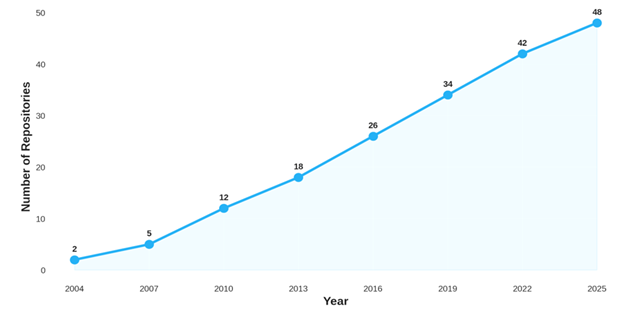
Figure 1
|
Figure 1 Institutional Repository Adoption Timeline
in Karnataka (2004-2025) Note: Data Represents
Estimated Trends Based on Literature Analysis and Institutional Reports |
3. RESEARCH OBJECTIVES
· To assess the current status of institutional repository implementation across Karnataka universities.
· To identify and analyze multidimensional challenges impeding repository development and sustainability.
· To develop a comprehensive AI-assisted theoretical framework for institutional repositories.
· To systematically identify critical research gaps requiring scholarly investigation and empirical validation.
· To formulate theoretical recommendations for future implementation and practical deployment initiatives.
4. RESEARCH METHODOLOGY
This theoretical investigation employs systematic literature review methodology covering publications from 2000-2025, conceptual framework development through iterative modeling, comparative analysis across institutional types, and structured gap identification techniques to synthesize existing knowledge and establish foundational frameworks for future empirical validation.
5. CURRENT STATUS ASSESSMENT OF KARNATAKA UNIVERSITY REPOSITORIES
1) Institutional
Landscape and Adoption Patterns
Karnataka's higher education ecosystem encompasses diverse institutional types presenting varying repository development profiles Mahesh and Kumar (2022). Premier research institutions typically demonstrate advanced repository implementations featuring comprehensive metadata standards, substantial content collections, sophisticated search capabilities, and strong international visibility through aggregator services. These institutions benefit from dedicated technical personnel, adequate infrastructure budgets, established digital scholarship cultures, and institutional mandates supporting repository operations.
State universities present more variable repository maturity profiles. While several have established functional repositories through Shodhganga participation, content deposit rates and technical sophistication differ substantially across institutions Katagi (2022). Factors influencing these variations include administrative commitment levels, library staff technical capabilities, faculty awareness and engagement, available financial resources, and institutional research output volumes.
Private universities exhibit the greatest variation in repository development. Some private institutions have invested substantially in repository infrastructure as components of broader digital transformation initiatives, while others maintain minimal or absent repository presences. This variation reflects differing institutional priorities, financial capacities, research emphases, and strategic orientations toward digital scholarship and open access principles.
Table 1
|
Table 1 Comparative Repository
Characteristics Across Karnataka University Types |
|||
|
Characteristic |
Premier Institutions |
State Universities |
Private Universities |
|
Repository
Presence (%) |
95 |
60 |
35 |
|
Average Content Items |
3,500+ |
400-800 |
100-500 |
|
Metadata
Quality |
Comprehensive |
Variable |
Limited |
|
Faculty Engagement |
High |
Moderate |
Low-Moderate |
|
Technical
Sophistication |
Advanced |
Intermediate |
Intermediate |
|
Open Access Compliance |
Strong |
Moderate |
Variable |
|
Note: Percentages Represent Estimated Average
Distribution Across Karnataka Repositories |
|||
2) Content
Analysis and Repository Population Dynamics
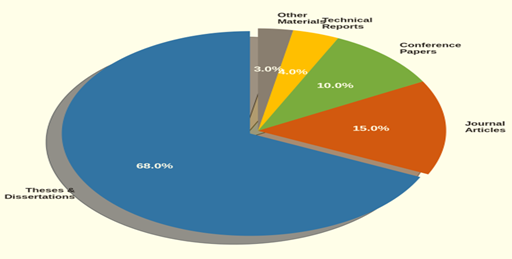
Content analysis reveals that electronic theses and dissertations constitute the predominant material category within Karnataka university repositories, consistent with national mandates and Shodhganga requirements Kumar and Arora (2015). However, inclusion of additional research outputs remains limited. Journal articles, despite representing substantial portions of faculty research productivity, appear infrequently in repositories due to copyright restrictions, publisher policies, and faculty concerns about premature disclosure Davis and Connolly (2007).
Metadata quality demonstrates substantial variation across repositories and institutions. Premier institutions typically maintain comprehensive metadata following Dublin Core and discipline-specific schemas, employing controlled vocabularies and authority files Bhat (2013). State and private universities exhibit more variable practices with frequent issues including incomplete metadata records, inconsistent field application, limited controlled vocabulary usage, inadequate rights documentation, and minimal abstract or keyword provision Roy and Mukhopadhyay (2022).
Table 2
|
Table 2 Challenges in
Institutional Repository Development: A Multi-Dimensional Analysis |
||
|
Challenge Category |
Specific Issues |
Frequency/Severity |
|
Content
Management |
Low
deposit rates, limited content diversity |
High |
|
Metadata Quality |
Inconsistency, incompleteness, poor standardization |
High |
|
Faculty
Engagement |
Reluctance
to deposit, awareness gaps |
Very
High |
|
Technical
Infrastructure |
Platform limitations, interoperability issues |
Moderate |
|
Sustainability |
Funding
uncertainty, staffing constraints |
High |
|
Policy Frameworks |
Absent or incomplete governance structures |
Very High |
|
User
Experience |
Poor
discoverability, limited customization |
Moderate-High |
|
Note:
Percentages Represent Estimated Average Distribution Across Karnataka
Repositories |
||
Figure 2
|
Figure 2 Distribution
of Content Types in Karnataka University Repositories Note: Percentages
Represent Estimated Average Distribution Across Karnataka Repositories |
6. AI-ASSISTED FRAMEWORK FOR INSTITUTIONAL REPOSITORIES
6.1. Proposed AI-Assisted Theoretical Framework
·
Framework Architecture and Conceptual Design
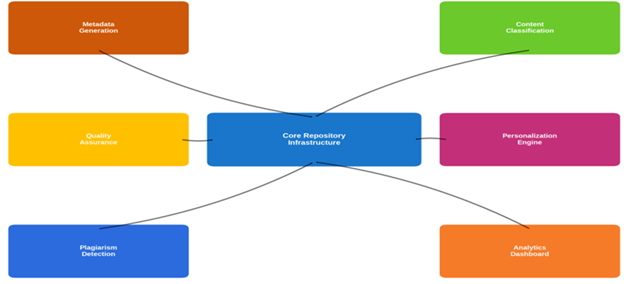
The proposed framework integrates artificial intelligence capabilities with existing repository infrastructure to address identified challenges while enhancing functionality, user experience, and operational efficiency Greyling (2025). The conceptual architecture comprises five interconnected layers operating synergistically to create an intelligent repository ecosystem. These layers include intelligent metadata management providing automated description generation and consistency maintenance, content curation and classification enabling automatic organization and trend identification, personalized discovery systems delivering customized user experiences, quality assurance mechanisms ensuring content integrity and standards compliance, and predictive analytics providing strategic insights for repository management.
Framework design emphasizes several critical principles ensuring practical applicability and sustainability. Compatibility with existing open-source platforms particularly DSpace and EPrints enables integration without complete system replacement Velmurugan (2013). Modular architecture allows incremental implementation beginning with high-value components. Scalability accommodates institutions of varying sizes and resources. User-centered design prioritizes intuitive interfaces and enhanced experiences. Ethical AI deployment addresses privacy, transparency, and accountability concerns Authors Alliance. (2025). Standards compliance maintains interoperability with external systems and aggregators.
·
Intelligent Metadata Management Layer
Automated metadata generation represents a foundational capability addressing the labor-intensive nature of manual description creation. Natural language processing algorithms analyze document full-text to extract essential bibliographic elements including titles, author names, publication dates, abstracts, and subject keywords. Machine learning models trained on high-quality existing metadata learn institutional conventions and standards, enabling consistent application across new deposits. Metadata enrichment processes automatically enhance basic descriptions with additional contextual information. Subject classification algorithms assign appropriate disciplinary categories and keywords from controlled vocabularies. Citation extraction identifies references enabling automatic relationship mapping. Language identification and translation capabilities support multilingual metadata creation, particularly valuable for Karnataka's diverse linguistic environment.
·
Content Curation and Classification Layer
Intelligent content curation employs machine learning classification algorithms to automatically categorize research outputs by multiple dimensions including subject disciplines, document types, research methodologies, and content formats. Topic modeling techniques identify latent themes and emerging research areas within repository collections, providing valuable intelligence for institutional research strategy and resource allocation. Content quality assessment mechanisms analyze documents across multiple quality dimensions. Completeness scoring evaluates metadata comprehensiveness and full-text availability. Format standardization checking identifies materials requiring conversion or enhancement. Accessibility compliance assessment verifies adherence to universal design principles. Preservation risk analysis identifies content requiring format migration or additional preservation actions Mahesh and Kumar (2022).
Table 3
|
Table 3 AI Technologies and
Their Repository Applications |
|||
|
AI Technology |
Implementation Method |
Repository Function |
Expected Benefits |
|
Natural
Language Processing |
Text
analysis, entity extraction, semantic understanding |
Metadata
generation, content analysis, search enhancement |
Reduced
manual effort, improved consistency, enhanced discoverability |
|
Machine Learning Classification |
Supervised learning, deep neural networks,
ensemble methods |
Content categorization, subject assignment,
format identification |
Automated organization, improved navigation,
trend identification |
|
Recommendation
Systems |
Collaborative
filtering, content similarity, hybrid approaches |
Personalized
suggestions, related content discovery |
Enhanced
engagement, improved satisfaction, increased usage |
|
Text Similarity Analysis |
Vector embeddings, cosine similarity, document
fingerprinting |
Plagiarism detection, duplicate identification,
content linking |
Academic integrity, quality assurance,
relationship discovery |
|
Predictive
Analytics |
Time
series analysis, regression models, pattern recognition |
Usage
forecasting, trend prediction, resource planning |
Proactive
management, strategic planning, resource optimization |
|
Computer Vision |
OCR, image recognition, figure extraction |
Image processing, diagram indexing, accessibility
enhancement |
Expanded searchability, improved accessibility,
enhanced usability |
Figure 3
|
Figure 3 AI-Assisted
Framework Architecture for Institutional Repositories Note: Arrows Indicate
Data Flow and Functional Integration Between Components |
7. CRITICAL RESEARCH GAPS AND FUTURE INVESTIGATION PRIORITIES
Comprehensive analysis of institutional repository development in Karnataka universities reveals substantial research gaps requiring scholarly investigation and empirical validation. These gaps span technical, organizational, social, and policy dimensions, collectively representing significant opportunities for advancing repository theory and practice.
·
Absence of Regional Coordination Mechanisms
Karnataka lacks comprehensive state-level coordination frameworks for institutional repository development, resulting in fragmented initiatives, redundant efforts, and missed opportunities for resource optimization and collaborative development. Research examining coordination framework design, governance structures, resource sharing models, policy alignment mechanisms, and implementation strategies specific to regional contexts represents a critical priority.
·
Limited Empirical Research on AI Integration
Despite theoretical discussions regarding artificial intelligence applications in repository management, empirical research documenting actual implementations, assessing effectiveness, identifying implementation challenges, and evaluating user acceptance remains severely limited Greyling (2025), Authors Alliance. (2025). The AI-assisted framework proposed in this study requires rigorous empirical validation through controlled experiments, pilot implementations, and longitudinal evaluations.
·
Insufficient Understanding of Participation
Dynamics
While faculty participation challenges are well documented Davis and Connolly (2007), deep understanding of underlying motivations, barriers, and facilitators within Karnataka university contexts remains limited. Research priorities include disciplinary differences in open access attitudes and behaviors, relationships between repository participation and academic reward structures, institutional culture influences on scholarly communication practices, and effective change management strategies.
·
Limited Research on Sustainability Models
Long-term financial and organizational sustainability represents a fundamental challenge for institutional repositories, yet research examining viable sustainability models for Indian universities remains limited. Critical questions include optimal staffing structures, sustainable funding mechanisms, cost-benefit analysis methodologies, partnership and consortium models, and strategies for maintaining institutional commitment beyond founding champions.
·
Inadequate Attention to Multilingual Content
Karnataka's multilingual academic environment produces substantial research outputs in Kannada and other regional languages. However, institutional repositories predominantly emphasize English-language content with inadequate attention to multilingual materials. Research gaps include best practices for multilingual metadata creation, technical requirements for non-Latin script support, and preservation considerations for digital Kannada materials.
·
Underdeveloped Policy Research and Framework
Development
Comprehensive policy frameworks encompassing copyright management, preservation standards, access policies, quality control procedures, and ethical guidelines for AI deployment remain underdeveloped within Karnataka contexts. Development of evidence-based policy templates adapted to Indian legal frameworks, institutional contexts, and cultural considerations represents an urgent priority.
·
Limited User-Centered
Research
User-centered research examining how diverse stakeholder groups discover, access, and utilize repository content remains limited within Karnataka contexts Marques and Borba (2017). Understanding user information-seeking behaviors, barriers to repository usage, preferences for content organization and presentation, mobile access patterns, and integration with research workflows is essential for designing effective user-centered repositories.
Table 4
|
Table 4 Summary of Research
Gaps and Proposed Investigation Approaches |
||
|
Research Gap |
Key Questions |
Investigation Approach |
|
Regional
Coordination |
Framework
design, governance, resource sharing |
Qualitative
analysis, case studies |
|
AI Integration |
Implementation feasibility, effectiveness |
Pilot projects, controlled studies |
|
Participation
Dynamics |
Motivation,
barriers, discipline variations |
Mixed-methods
research, surveys |
|
Sustainability Models |
Funding mechanisms, staffing structure |
Organizational analysis, comparative studies |
|
Multilingual
Content |
Script
support, metadata creation |
Technical
assessment, policy research |
|
Policy Development |
Standards, IP management, ethics |
Policy analysis, stakeholder consultation |
|
User
Behavior |
Discovery
patterns, preferences, workflows |
User
studies, behavioral analysis |
8. THEORETICAL RECOMMENDATIONS FOR FUTURE RESEARCH AND IMPLEMENTATION
This theoretical investigation proposes recommendations for future research and eventual practical implementation of the AI-assisted framework and broader repository development initiatives. These recommendations are grounded in comprehensive literature analysis and theoretical modeling rather than empirical validation, recognizing that actual implementation will require substantial additional research, testing, and refinement based on institutional contexts and stakeholder needs.
·
Phased Approach for Future Development
Future implementation efforts should adopt phased approaches prioritizing high-value, lower-risk components initially while building toward comprehensive integration. Initial phases might focus on automated metadata generation capabilities offering immediate practical value with relatively straightforward implementation. Subsequent phases could progressively add content classification, recommendation systems, quality assurance mechanisms, and advanced analytics. This incremental strategy enables iterative learning, stakeholder familiarization, and capability demonstration while managing implementation complexity and resource requirements.
Institutional selection for future implementation should consider diversity across institution types, sizes, and repository maturity levels to ensure framework applicability across varied contexts. Selection criteria might include demonstrated administrative commitment through resource allocation and policy support, existing repository infrastructure providing implementation foundations, willingness to participate in research activities including data collection and evaluation, and technical capacity for system implementation and maintenance.
·
Stakeholder Engagement and Capacity Building
Successful repository development requires comprehensive stakeholder engagement and capacity building strategies addressing cultural, organizational, and behavioral dimensions Sinha and Satpathy (2017). Faculty members require awareness programs emphasizing repository benefits, copyright guidance, deposit workflow instruction, and integration with existing research practices. Graduate students benefit from training on thesis preparation standards, repository submission procedures, and utilizing repository resources.
Change management strategies should address cultural barriers to repository adoption through multiple approaches. Aligning participation incentives with academic reward structures by recognizing repository contributions in promotion decisions can motivate faculty engagement. Celebrating early adopters creates social proof effects. Addressing copyright concerns through clear guidelines reduces participation barriers. Demonstrating tangible benefits including increased research visibility strengthens value propositions.
Table 5
|
Table 5 Recommended Phased
Approach for Future Framework Development |
|||
|
Phase |
Timeline |
Primary Objectives |
Key Components |
|
Phase
1: Foundation |
Months
1-6 |
Pilot
site selection, stakeholder engagement |
Planning,
consultation, site preparation |
|
Phase 2: Development |
Months 7-18 |
Initial implementation, metadata automation |
System setup, staff training, module 1 deployment |
|
Phase
3: Enhancement |
Months
19-30 |
Content
curation, advanced features |
Classification
algorithms, quality assurance |
|
Phase 4: Evaluation |
Months 31-36 |
Impact assessment, scalability testing |
Evaluation studies, refinement |
|
Phase
5: Dissemination |
Months
37-42 |
Regional
deployment, knowledge transfer |
Replication,
policy development |
9. CONCLUSION
This theoretical investigation has examined institutional repository development in Karnataka universities, identifying critical research gaps and proposing an artificial intelligence-assisted framework to enhance repository functionality and address persistent challenges. Analysis reveals that while Karnataka possesses substantial higher education infrastructure with several well-established repositories, significant variations persist across institution types in adoption maturity, content population, technical sophistication, and sustainability practices Mahesh and Kumar (2022), Katagi (2022).
The proposed AI-assisted framework offers a comprehensive, theoretically-grounded approach integrating intelligent metadata management, automated content curation, personalized discovery systems, quality assurance mechanisms, and predictive analytics capabilities Greyling (2025). This framework balances technological innovation with practical implementation considerations, recognizing that sustainable repository development requires coordinated attention to technical, organizational, cultural, and policy dimensions Sinha and Satpathy (2017).
Seven critical research gaps have been identified requiring scholarly investigation and empirical validation. These encompass regional coordination mechanisms, technology integration strategies, stakeholder participation dynamics, sustainability models, multilingual content management, policy framework development, and user behavior understanding. Addressing these gaps through focused research programs, empirical studies, and collaborative initiatives will substantially advance institutional repository development in Karnataka while potentially providing models applicable to broader contexts.
As Karnataka universities navigate digital transformation challenges, institutional repositories represent both essential infrastructure and strategic opportunities. By embracing technological innovation, addressing identified research gaps, implementing evidence-based frameworks, and fostering collaborative networks, Karnataka can advance institutional repository development contributing to regional educational advancement and broader scholarly communication ecosystems. This theoretical investigation provides a conceptual foundation for that development trajectory, combining rigorous analysis with forward-looking frameworks to guide future research and implementation efforts.
CONFLICT OF INTERESTS
None.
ACKNOWLEDGMENTS
None.
REFERENCES
Authors Alliance. (2025). Institutional Repositories and AI Scraping: Implications for Content Discovery and Scholarly Communication.
Bhat, M. H. (2013). Exploring Research
Data in Indian Institutional
Repositories. Program: Electronic
Library and Information Systems, 47(2), 165-184.
Davis, P. M., & Connolly, M.
J. L. (2007). Institutional
Repositories: Evaluating the
Reasons for Non-Use of Cornell University's
installation of DSpace. D-Lib Magazine, 13(3/4),
1-14.
Greyling, C. (2025). Ai-Driven Knowledge Management Turns Repositories into Intelligent Ecosystems. Reworked Magazine.
Gusenbauer, M., & Haddaway, N. R. (2020). Which Academic Search Systems are Suitable for Systematic Reviews or Meta-Analyses? Evaluating Retrieval Qualities of Google Scholar, PubMed, and 26 Other Resources. Research Synthesis Methods, 11(2), 181-217. https://doi.org/10.1002/jrsm.1378
INFLIBNET Centre. (2024). Shodhganga: A Reservoir of Indian theses. Information and Library Network Centre. https://www.inflibnet.ac.in/
Katagi, S. (2022). Contribution to National
Repository of Electronic Theses
and Dissertations by the Universities of Karnataka: A Case Study of Shodhganga. Journal of Indian
Library Association, 58(2), 17-28.
Krishnamurthy, M., & Kemparaju, T. D. (2011). Institutional Repositories in Indian Universities and Research Institutes: A Study. Program: Electronic Library and Information Systems, 45(2), 185-198.
Kumar, M., & Arora, J. (2015). Shodhganga and Deterring
Plagiarism in Research
Outputs in Indian Universities.
In Proceedings of 10th International CALIBER 2015
(524-533). INFLIBNET Centre.
Lynch, C. A. (2003). Institutional Repositories: Essential Infrastructure for Scholarship in the Digital Age. Portal: Libraries and the Academy, 3(2), 327-336. https://doi.org/10.1353/pla.2003.0039
Mahesh, V. M., & Kumar, R. A.
(2022). Open Access Institutional
Repositories in India: A Status Report. Library Philosophy and Practice, 7045, 1-15.
Marques, G., & Borba, G. S. (2017). User-Centered Design in Institutional Repositories: Lessons Learned and Future Directions. Digital Library Perspectives, 33(4), 324-341. https://doi.org/10.1108/DLP-08-2017-0031
Roy, B. K., & Mukhopadhyay, P.
(2022). An Analytical Study of Institutional Digital
Repositories in India. Library Philosophy
and Practice, 692, 1-18.
Sinha, M. K., & Satpathy, K. C. (2017). Introducing Institutional
Repositories in University and Institutional
Libraries of India for Open
Access. In K. C. Satpathy (Ed.), Digital library and Open Access Initiatives:
Responses, Strategies and Emerging Trends (215-235). Shankar's
Book Agency.
Velmurugan, C. (2013). Open Source Software:
An Institutional Digital Repository System with Special Reference to DSpace Software in Digital Libraries.
International Journal of Advanced Research in
Computer Science and Software Engineering, 3(10), 313-318.
|
|
 This work is licensed under a: Creative Commons Attribution 4.0 International License
© ShodhAI 2025. All Rights Reserved.