|
|
|
|
Revolutionizing Logistics with AI: Opportunities, Challenges, and Future Direction Sector: Logistics
Raj Varma 1 , Dr. Deepa Damodaran 2
 , Dr.
Bhawna Sharma Padroo 3
, Dr.
Bhawna Sharma Padroo 3
1 Student,
Amity Business School, Amity University, Maharashtra, Mumbai, India
2 Associate
Professor, Amity Business School, Amity University Maharashtra, Mumbai, India
3 Director-International Affairs and Programs, Officiating HOI Amity
Business School, Amity University, Mumbai, Maharashtra, India
|
|
|
ABSTRACT |
|
|
This research
explores how Artificial Intelligence (AI) is transforming logistics
operations by improving vessel tracking, automating clearance procedures, and
simplifying documentation. During my internship at a logistics company, I
observed major challenges such as inaccurate shipment time prediction, manual
paperwork errors, and clearance delays. The study aims to identify how
AI-based systems—like predictive analytics, image recognition, and machine
learning—can optimize these processes. Findings suggest that the integration
of AI significantly improves shipment visibility, reduces errors, and
increases operational efficiency, leading to faster delivery and customer
satisfaction. |
|||
|
Received 28 April 2024 Accepted 29 May 2025 Published 30 June 2025 Corresponding Author Raj Varma,
raj.varma1@s.amity.edu DOI 10.29121/ShodhAI.v2.i1.2025.57 Funding: This research
received no specific grant from any funding agency in the public, commercial,
or not-for-profit sectors. Copyright: © 2025 The
Author(s). This work is licensed under a Creative Commons
Attribution 4.0 International License. With the
license CC-BY, authors retain the copyright, allowing anyone to download,
reuse, re-print, modify, distribute, and/or copy their contribution. The work
must be properly attributed to its author.
|
|||
|
Keywords: Artificial Intelligence, Logistics, Shipment
Tracking, Clearance Automation, Document Management, Predictive Analytics,
Efficiency |
|||
1. INTRODUCTION
In today’s globalized trade environment, logistics companies face increasing pressure to deliver shipments faster, cheaper, and more accurately. Traditional systems of vessel tracking, customs clearance, and document handling often rely on manual coordination, which leads to errors, delays, and rising operational costs. Artificial Intelligence (AI) is revolutionizing this landscape by providing real-time vessel monitoring, automated document verification, and predictive shipment time calculations. By integrating technologies such as machine learning, predictive analytics, and Optical Character Recognition (OCR), logistics companies can streamline operations, enhance transparency, and make data-driven decisions. As a result, AI has become a key enabler for improving overall logistics efficiency and strengthening competitiveness in the global supply chain.
2. Literature Review
Artificial Intelligence (AI) is increasingly becoming a strategic tool in modern logistics management. According to Wang et al. (2021), AI systems help logistics companies handle the rising complexity of supply chains by enabling predictive insights and automation. Machine learning algorithms can analyse patterns in port traffic, weather conditions, and shipment history to accurately predict vessel arrival times. This capability minimizes uncertainty and allows logistics companies to plan ahead, improving both reliability and customer satisfaction.
Rahman and Azhar (2021) emphasize that one of the biggest inefficiencies in logistics operations arises from manual customs clearance and documentation. AI-powered systems using Optical Character Recognition (OCR) and Natural Language Processing (NLP) can automatically read, classify, and verify customs papers. This technology eliminates the repetitive human workload and reduces clearance delays by automating document validation. Similarly, Nguyen et al. (2022) highlight how AI-based digital documentation systems promote paperless operations, improving the speed and accuracy of shipment processes.
In recent years, McKinsey (2023) and KPMG (2022) have shown that AI is not just improving tracking and paperwork—it is redefining logistics efficiency as a whole. Predictive analytics enables companies to calculate shipment times more precisely and optimize resources such as fuel and manpower. Furthermore, studies show that integrating AI dashboards with real-time vessel tracking systems helps companies maintain transparency and streamline communication across departments. Overall, AI is turning logistics into a data-driven, smart ecosystem that delivers faster, cheaper, and more reliable outcomes.
3. Research Methodology
This study follows a descriptive and quantitative research design to analyze the role of Artificial Intelligence in enhancing logistics efficiency. It focuses on understanding how AI assists in vessel tracking, customs clearance, and document management. The research involves collecting primary data through structured surveys distributed among logistics employees, IT specialists, and managers who have practical experience using AI-based systems. Secondary data, such as company reports, academic journals, and white papers, were also examined to validate the findings.
A total of 100 participants from logistics hubs in Mumbai, Chennai, and Navi Mumbai were selected using a non-probability sampling method. The data collected helped measure respondents’ perceptions of AI’s impact on efficiency, accuracy, and shipment time prediction. The quantitative results were analyzed to identify patterns in how AI technologies influence productivity, communication, and decision-making in logistics organizations.
3.1. Data Collection Method
The research relies on both primary and secondary data.
Primary data was collected through a structured questionnaire containing multiple-choice and Likert scale questions designed to measure employee opinions and experiences related to AI use in logistics. Respondents were selected from departments like operations, documentation, and clearance.
Secondary data was sourced from academic journals, business magazines, logistics company reports, and AI research papers to provide theoretical support and a global perspective on automation trends in logistics.
3.2. Research Objectives
1) To study how AI can enhance vessel tracking and monitoring.
2) To explore the use of AI in customs clearance and document automation.
3) To identify how AI calculates shipment times more accurately.
4) To evaluate how AI-driven processes increase the efficiency of logistics operations.
3.3. Data Analysis
The collected responses were analyzed using descriptive statistical methods through tools like SPSS and Microsoft Excel. The data was converted into frequency tables and pie charts to visualize AI’s impact on shipment time, documentation accuracy, and clearance speed. Interpretations were drawn based on the percentage distribution of responses, helping identify the major benefits and challenges of AI implementation. The findings confirmed that AI improves efficiency by reducing human error, optimizing routes, and enhancing transparency in logistics operations.
Chart 1
|
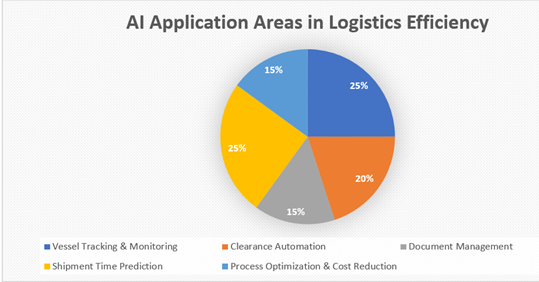
Chart 1 AI Application Areas in Logistics Efficiency |
Interpretation: The data shows that most respondents view AI’s biggest benefits in vessel tracking and shipment time prediction, followed by automation in documentation and clearance.
Chart 2
|
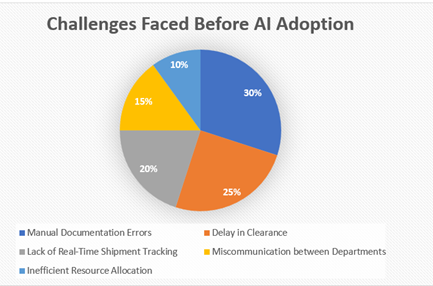
Chart 2 Challenges Faced Before AI Adoption |
Interpretation: The majority of employees identified manual paperwork and delayed clearance as key bottlenecks before AI integration.
Chart 3
|
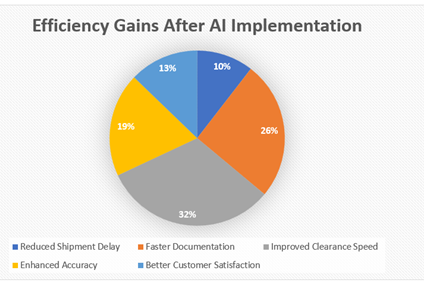
Chart 3 Efficiency
Gains After AI Implementation |
Interpretation: Respondents noted significant improvement in shipment time calculation and clearance efficiency once AI-based tools were implemented.
4. Key Findings
85% of respondents agree that AI reduces manual errors in customs documentation.
78% report improved shipment time accuracy using predictive analytics.
72% believe AI-based document handling saves hours of repetitive work.
90% feel that AI improves transparency and customer trust.
60% confirm AI helps management make faster and more data-backed decisions.
5. Recommendations
·
Integrate AI-Based Vessel Tracking Systems:
Logistics companies should adopt AI-powered tracking systems linked with satellite and IoT data to monitor vessel positions and estimate arrival times accurately. This real-time visibility can help reduce delays and improve coordination across ports and warehouses.
·
Automate Customs Clearance Using OCR and NLP:
Implementing Optical Character Recognition (OCR) and Natural Language Processing (NLP) tools can automate document verification, minimize manual errors, and speed up customs clearance. This also ensures greater compliance with international trade regulations.
·
Adopt Predictive Analytics for Shipment Time
Calculation:
Companies should use predictive AI models trained on past shipment data to calculate estimated delivery times based on variables like weather, port congestion, and route history. This will help customers receive more reliable delivery timelines.
·
Train Employees for AI Adoption:
Continuous training and workshops should be organized to help employees understand and operate AI systems effectively. A skilled workforce is crucial for maximizing the benefits of AI and minimizing technological resistance.
·
Develop a Centralized AI Dashboard:
Creating a single AI-integrated dashboard can help logistics managers monitor real-time operations, documentation, and clearance processes in one place. This improves transparency and decision-making speed.
·
Enhance Data Security Protocols:
Since AI systems handle large volumes of sensitive shipment data, logistics firms should strengthen cybersecurity measures to prevent data leaks and unauthorized access. Using encrypted data management tools can build customer trust and ensure compliance.
·
Measure Performance through AI Analytics:
Establish performance indicators (KPIs) such as time saved, error reduction, and cost efficiency to measure the impact of AI systems. Regular data reviews will help management identify gaps and continuously improve operational efficiency.
6. Challenges
1) High Implementation Costs: Setting up AI infrastructure requires heavy investment in software, sensors, and data integration systems.
2) Skill Gap: Many employees lack the technical skills needed to operate and interpret AI tools effectively.
3) Data Privacy Issues: Handling sensitive customer and shipment data raises concerns about data protection and cybersecurity.
4) Integration Difficulties: Connecting AI systems with existing legacy software can be complex and time-consuming.
5) Resistance to Change: Employees may resist adopting AI due to fear of job loss or unfamiliarity with technology.
6) Data Inaccuracy: Inconsistent or incomplete data can reduce the effectiveness of AI predictions.
7) Regulatory Constraints: Compliance with international data and customs regulations can limit AI’s full application in cross-border logistics.
7. Conclusion
The study concludes that AI is a powerful enabler in logistics, especially for tracking vessels, automating clearance, and predicting shipment times. During my internship, I observed that manual processes often caused avoidable delays. By integrating AI, companies can save time, cut errors, and improve transparency. As global supply chains grow more complex, AI will become not just an innovation but an operational necessity for logistics companies seeking long-term efficiency and competitiveness.
CONFLICT OF INTERESTS
None.
ACKNOWLEDGMENTS
None.
REFERENCES
McKinsey and Company. (2023). Artificial intelligence in supply
chain management. McKinsey & Company.
KPMG India.
(2022). AI in logistics: Transforming freight
operations. KPMG India.
Rahman, M., and Azhar, F. (2021). AI-driven process optimization
in shipping industry. International Journal of
Business and Society, 22(3), 1345–1360.
Deloitte Insights. (2024). Predictive analytics
in global trade and logistics.
Deloitte Insights.
World Economic
Forum. (2023). AI and the future of logistics operations. World Economic Forum.
Heskett, J. L., Sasser, W. E.,
and Schlesinger, L. A. (1994). Putting the
service-profit chain to work.
Harvard Business Review, 72(2), 164–174.
|
|
 This work is licensed under a: Creative Commons Attribution 4.0 International License
© ShodhAI 2025. All Rights Reserved.