|
|
|
|
Healthcare Security with Blockchain In India
Smita Desai 1
 ,
Bharati Ambali 2

1 Vice
Principal, BCA Department, Bharatesh College of
Computer Applications, Belagavi, Karnataka, India
2 Lecturer,
BCA Department, Bharatesh College of Computer
Applications, Belagavi, Karnataka, India
|
|
|
ABSTRACT |
|
|
The literature
review examines the blockchain applications in healthcare, it focuses on its
capabilities to address the critical challenges faced by traditional data
management systems. Blockchain's decentralized, transparent, and immutable
nature offers robust solutions for safeguarding sensitive health information,
ensuring data integrity, and facilitating secure data exchanges among
healthcare providers. The review begins with an exploration of blockchain
fundamentals and theoretical perspectives on technology adoption. It then
delves into the specific applications of blockchain in healthcare, including
data security, patient privacy, interoperability, and the enhancement of
trust and transparency. Case studies from various global implementations
illustrate the practical benefits and challenges of deploying blockchain in
healthcare settings. Despite the promising advantages, the review identifies
several challenges and limitations, such as technical scalability issues,
regulatory compliance, and adoption barriers. Comparative analyses highlight
the superiority of blockchain over traditional systems in terms of security
and efficiency. The review concludes with an outlook on future trends and
innovations, suggesting that integrating blockchain with emerging
technologies like IoT and AI could further enhance healthcare outcomes. This
comprehensive examination underscores the transformative potential of
blockchain in creating a secured healthcare system while calling for
continued research and collaboration to address existing barriers and fully
realize its benefits. |
|||
|
Received 22 July 2024 Accepted 02 August 2024 Published 14 August 2024 Corresponding Author Smita
Desai, smita.desai.sd3@gmail.com
DOI 10.29121/ShodhAI.v1.i1.2024.6 Funding: This research
received no specific grant from any funding agency in the public, commercial,
or not-for-profit sectors. Copyright: © 2024 The
Author(s). This work is licensed under a Creative Commons
Attribution 4.0 International License. With the
license CC-BY, authors retain the copyright, allowing anyone to download,
reuse, re-print, modify, distribute, and/or copy their contribution. The work
must be properly attributed to its author.
|
|||
|
Keywords: Blockchain Technology, Healthcare Security,
Healthcare Innovation, Data Breaches |
|||
1. INTRODUCTION
The swift advancement of digital technology has transformed many sectors, including healthcare. However, this digital transformation has also introduced significant challenges, that includes data security and patient privacy. The inherent features of Blockchain technology decentralization, transparency, and immutability, offers a favorable solution to these challenges.
Blockchain technology has emerged as a promising solution to improve the healthcare sector security globally, including in India. This literature review explores the application of blockchain in the Indian healthcare sector, focusing on its ability to address security, privacy, interoperability, and trust issues. The integration of blockchain aims to revolutionize data management practices, ensuring secure and transparent healthcare operations.
HIPAA a rigorous regulatory constraints causes more rigorous authentication in blockchain applications in the healthcare industry usually require, interoperability, and record sharing requirements. In this article the focus is on the significance of blockchain technology with two perspective :application and technical for healthcare domain. The main discussion of this article is features and use-cases of blockchain in different applications along with the healthcare domain interoperability. A summary of the current state-of-the-art research in healthcare blockchain and existing blockchain-based healthcare applications is provided. Additionally, the challenges and future research opportunities, along with the performance evaluation metrics for implementing blockchain technology in healthcare, are presented to provide insights for future research. We also outline the various security attacks on the blockchain protocol, classify threat models, and provide a comparative analysis of detection and protection techniques. The other discussions are different methods to enhance the security and privacy of the blockchain network.
1) Theoretical
Framework
Blockchain can be viewed as a decentralized digital ledger technology that records transactions across multiple computers in a manner that prevents retroactive alteration of registered transactions. Key concepts within blockchain technology include:
Smart Contracts: These are Self-executing contracts, known as smart contracts, have terms of the agreement directly written into code. These contracts automatically execute and enforce their terms once predefined conditions are met, without requiring intermediaries.
Consensus Mechanisms: Methods that ensure agreement on the data's validity across the network.
In the context of healthcare, data privacy refers to protecting patients' personal health information (PHI), ensuring it is only accessible to authorized individuals and systems. The Technology Acceptance Model (TAM) and Institutional Trust Theory provide theoretical insights into the adoption and acceptance of blockchain technology in healthcare. These theories emphasize factors such as perceived usefulness, ease of use, and trustworthiness in influencing stakeholders' attitudes towards adopting blockchain solutions.
Increasing Fascination with Blockchain Technology
Recently, there has been a growing interest in blockchain technology, primarily due to its success in the cryptocurrency domain Narayanan et al. (2016). The potential for blockchain-based applications is expanding into various fields such as healthcare Yue et al. (2016), Zhang et al. (2018a), finance Treleaven et al. (2017), commerce Liu et al. (2019a), IoT Miller (2018), social services Zheng et al. (2018a), automobile Sharma et al. (2019), financial departments Ojo and Adebayo (2017), risk management systems Fu and Zhu (2019), government transactions Ølnes et al. (2017) and royalty payments Carson et al. (2018).
Blockchain technology ensures expedient and reliable services Joshi et al. (2018) due to its transparent and distributed nature. Specifically, Blockchain systems are recognized as secure platforms Ramachandran and Kantarcioglu (2017), where participants' actions are permanently recorded on the blockchain. The continuous accumulation of transaction blocks within the chain makes any attempt to alter previous records computationally challenging and easily detectable Zhu et al. (2019) . This immutability and transparency are key features that contribute to the security and trustworthiness of blockchain technology in various applications.
2. Overview of Healthcare Systems in India
India's healthcare system faces challenges related to data security, interoperability, and patient privacy. Traditional centralized systems are vulnerable to data breaches and lack efficient mechanisms for secure data exchange between healthcare providers. Several case studies illustrate the vulnerabilities of Indian healthcare systems to cyber threats and data breaches. Instances like unauthorized access to Aadhaar data and breaches in health information systems highlight the urgent need for robust security measures.
Total healthcare spending in India, stands at 3.6% of GDP, according to the Organisation for Economic Co-operation and Development (OECD), significantly lower than many other countries Mehra (2020). However, there are optimistic plans to increase this expenditure to around 5% by 2025. Despite these efforts, India continues to face challenges in establishing an accessible and trusted healthcare ecosystem for its stakeholders, including health service providers, governance, and citizens. The healthcare system in India remains unstable due to limited and mismanaged resources, as well as opaque service compliance, and unpredictable treatment expenses. Additionally, the unequal distribution of medical facilities between rural and urban areas has resulted in disparities in healthcare delivery for residents in these regions.
The government is investing substantial amounts to deliver quality healthcare to the underprivileged population. The promise of the ‘right to health’ is central to the targets envisioned by the government under the Millennium Development Goals. The Indian government has launched multiple programs and schemes, such as the National Population Policy, 2000, and the National AIDS Prevention and Control Policy, 2004. In 2015, more than a decade after the second policy in 2002, India introduced its third National Health Policy (NHP). With NHP 2015, the government aims to reposition health as a major agenda, linking economic development to health. This policy was designed to identify and address gaps in the Indian healthcare system, providing a framework to meet health targets.
Recently, the government launched the Ayushman Bharat Yojana under the National Health Policy scheme of 2017, which plans to open 1.5 lakh healthcare centers to provide holistic healthcare across the country. Another positive development in India's healthcare ecosystem is the transformation of physical infrastructure and technological capabilities due to market liberalization and increased private sector involvement Shah (2010).
2) Application
of Blockchain in Indian Healthcare
Blockchain technology is anticipated to offer substantial synergies in resolving challenges within the healthcare ecosystem Bhattacharya et al. (2019), Sharma et al. (2019). While Information Systems research often focuses on protocol or technology-level decisions within blockchain ecosystems, it also considers application-level, human agent, stakeholder involvement, and behavioural and economic premises Chanson et al. (2019), Rossi et al. (2019). However, research on blockchain technology adoption within the Indian healthcare ecosystem, particularly from the perspective of stakeholders' requirements, is limited and seldom explored. Addressing this research gap, we use Value-Focused Thinking (VFT) Keeney (1992), Parekh et al. (2020), Pawar et al. (2020), Smith et al. (2020) to assess blockchain technology adoption in the Indian healthcare ecosystem.
VFT is a proactive and creative technique that helps identify the key values driving the strategic goals of a given research premise Keeney (1992), Shukla et al. (2018). It identifies a set of fundamental objectives that support strategic goals and align with the overall strategic vision. This hierarchical approach allows for articulating and analyzing the requirements of all key stakeholders Benkert (2020), May et al. (2013). Based on the needs of the Indian healthcare system, this paper aligns key attributes of blockchain technology—such as trust, traceability, transparency, immutability, and decentralization—with the system's requirements. We conduct a requirement elicitation process for blockchain technology in the Indian healthcare system using Value-Focused Thinking, engaging with various stakeholders to address the following key research questions:
Identifying the key challenges of the Indian healthcare system that can be addressed by blockchain technology, based on existing practices and research insights. Developing a strategy for optimal blockchain technology adoption in Indian healthcare by tailoring and prioritizing blockchain attributes and structural changes to best suit the Indian healthcare ecosystem.
Providing recommendations for managing change during the adoption of blockchain technology journey in Indian healthcare, based on preferences gathered from stakeholder input. This work contributes to existing research in Information Systems by offering insights into change management strategies for blockchain technology in the Indian healthcare ecosystem. It emphasizes the critical premise of customizing and prioritizing blockchain attributes based on their suitability to different aspects of Indian healthcare from a stakeholder perspective. The significance of infrastructure, awareness, and training is emphasized, along with the concept of phased and selective implementation of blockchain technology. These aspects consider the human dimension of existing research and contribute to the behavioural aspects of technology adoption. This work can assist in effective scenario planning based on the needs of key stakeholders in Indian healthcare, helping to initiate strategic discussions on blockchain adoption.
3. Challenges and Limitations
Blockchain technology faces several technical challenges that must be addressed for its widespread adoption and effective implementation in the Indian healthcare sector. These include:
Scalability Issues: Blockchain networks often struggle to handle a high volume of transactions efficiently.
Transaction Speed: Slow transaction speeds can hinder real-time data processing and decision-making.
Energy Consumption: High energy consumption associated with blockchain operations is a concern for sustainability.
Addressing these challenges is essential for the successful implementation of blockchain in Indian healthcare.
3) Regulatory
Landscape
Navigating India's complex regulatory landscape poses additional challenges for blockchain implementation. This includes:
Data Protection Laws: Ensuring compliance with India's data protection regulations is critical.
Healthcare Regulations: Adhering to healthcare-specific laws and standards is necessary for legal and safe implementation.
Clear guidelines and collaboration between stakeholders are essential to ensure compliance and legal adherence.
Table 1
|
Table 1 Layer Wise Security Challenges in Blockchain |
|||
|
Layers |
Security
Modules |
Attack
Type |
System
design challenges |
|
Physical
Layer |
Tamper
evidence, Tamper response, Detachment detection |
Physical
damage Jamming |
Device
connection, recovery, condition monitoring, |
|
Data
Layer |
Key
management, Cryptographic components |
Quantum
attack |
Merkle
tree, data blocks and code vulnerability |
|
Network
Layer |
Anonymous
internet communication technology |
Manipulation
based attacks cryptanalytic attacks |
Node's
network topology, Privacy protection issues, Centralized/Decentralized mixer |
|
Consensus
Layer |
PoS, PoW, BFT, Sharding |
51%
attack |
Scalability,
security assumptions, complexity, reconstruction |
|
Incentive
Layer |
Strategic
behavior detection, Optimization mechanism |
Selfish
mining |
Rewards
distribution, block withholding, unsustainable problem |
|
Contract
Layer |
Formal
validation, Sandbox environment, Test network |
Service
based attacks |
Formal
verification, Privacy issues, Exploited code |
|
Application
Layer |
Regulatory
mechanism |
Identity
based attack Reputation based attacks |
Authentication,
Identity management, trust establishment |
4) Barriers
to Adoption
Several significant barriers impede blockchain adoption in Indian healthcare:
Resistance to Change: Healthcare professionals and organizations may be resistant to adopting new technologies.
Lack of Awareness: There is a general lack of understanding about blockchain technology among healthcare professionals and policymakers.
High Implementation Costs: The costs associated with implementing blockchain technology can be prohibitive.
5) Education
and Training
To overcome these barriers, comprehensive education and training programs are essential. These programs should aim to:
Increase Understanding: Educate healthcare professionals and policymakers about the benefits and functionalities of blockchain technology.
Promote Acceptance: Address concerns and resistance by demonstrating the value and efficiency of blockchain solutions.
Support Implementation: Provide practical training on implementing and managing blockchain systems.
Addressing technical challenges, navigating regulatory hurdles, and overcoming barriers to adoption are crucial steps for the successful implementation of blockchain technology in Indian healthcare. Through education, training, and strategic collaboration, stakeholders can foster an environment conducive to the acceptance and effective use of blockchain, ultimately enhancing the healthcare ecosystem in India.
Figure 1

|
Figure 1 Challenges
in Healthcare |
4. Comparative Analysis and Future Directions
Blockchain is poised to revolutionize the healthcare system by utilizing its decentralized principles to improve patient information accessibility and security, thereby challenging the traditional healthcare hierarchy and empowering individuals to govern their treatment Singh et al. (2021). In conventional healthcare systems, sensitive medical records often lack a secure framework, leading to significant data breaches. Additionally, patients typically do not have full control over their medical data, a critical issue as personalized treatment and wearable technology become more prevalent. These situations raise important ethical considerations that must be addressed.
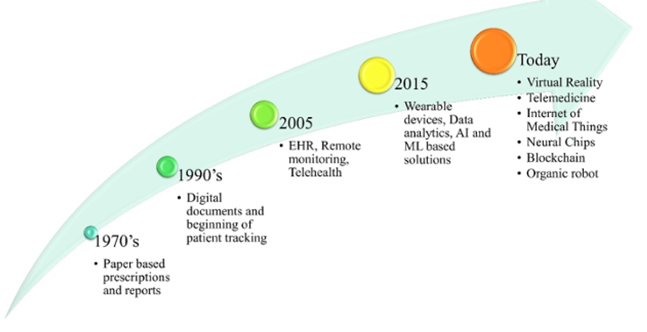
The healthcare domain has experienced significant growth with the advent of technologies associated with Industry 4.0. The transition from paper-based systems to electronic healthcare records (EHR) and electronic medical records (EMR) has improved patient data management and facilitated healthcare research. Recent advancements such as telemedicine and the Internet of Medical Things (IoMT) are further transforming the healthcare landscape. Blockchain technology can play a crucial role in this transformation by improving mobile health applications, monitoring devices, sharing and storing electronic medical records, managing clinical trial data, and storing insurance information, among other applications Omar et al. (2021).
Practitioners and researchers in Healthcare system often face challenges with fragmented data, delayed communications, and inadequate workflow tools. Another critical issue is the absence of secure connections capable of linking autonomous healthcare frameworks to establish a comprehensive and accessible end-to-end system Xiang and Zhao (2022). Managing and maintaining e-health records remains a struggle in the healthcare sector Zhang et al. (2018a). Blockchain technology can address these issues by providing trustless transactions through decentralization and virtual anonymity.
Comparative studies of global blockchain implementations in healthcare highlight its effectiveness in improving security and efficiency. These comparisons offer valuable insights into best practices and potential areas for improvement in India. The future of blockchain in Indian healthcare holds promise for innovation and enhanced healthcare delivery. Integrating blockchain with emerging technologies such as AI and IoT can further optimize healthcare processes and outcomes. Continued research and development are crucial to Optimizing the advantages of blockchain technology in addressing healthcare challenges.
In summary, blockchain technology is poised to revolutionize the healthcare system by ensuring secure, decentralized, and patient-governed data management. Its integration with other advanced technologies can propel the Indian healthcare sector towards a more efficient, transparent, and patient-centric future.
Figure 2
|
Figure 2 Evolution
of Healthcare Sysetm. |
To share the information across organizations by using blockchain as a distributed ledger among networks, Hyperledger Fabric Wutthikarn and Hui (2018) is the solution in this electronic health record. Companies such as Ripple, Ethereum, Quorum, Corda, NEO, NEM, and several others have introduced numerous blockchain platforms. Tele surgery Vora et al. (2017) which allows a doctor to perform real surgeries with the help of robots and wireless communication systems is the application of telemedicine. It saves time, expenses, and can help overcome the shortage of doctors. Medblocks Enescu et al. (2018) is a blockchain-based application aimed at enhancing decentralization in the medical and other fields.
Figure 3

|
Figure 3 Challenges of Healthcare
Domain. |
Blockchain has been extensively utilized for patient data management, primarily to enhance security and cost-effectiveness. It facilitates the electronic storage of medical data, management of patient appointments, handling of billing and accounts, and performance of lab tests Shahnaz et al. (2019). Blockchain is incorporated into many electronic health record (EHR) systems used within the healthcare industry. The primary objective is to deliver medical records that are safe, tamper-proof, and shareable across various platforms.
With various levels of management by patients, physicians, regulators, hospitals, insurers, and other stakeholders, blockchain ensures the maintenance of each patient's complete medical history. It offers a secure method to record and preserve comprehensive health information for each patient, thereby enabling a reliable and efficient healthcare system.
Figure 4

|
Figure 4 Applications of Blockchain in
Healthcare System. |
Blockchain technology offers significant potential to transform healthcare security in India by effectively addressing critical issues such as data security, privacy, interoperability, and trust. Despite facing challenges like technical complexities, regulatory frameworks, and adoption barriers, proactive measures and collaborative efforts can mitigate these challenges. The integration of blockchain into the Indian healthcare system promises to establish a secure, transparent, and efficient ecosystem that emphasizes patient-centric care and ensures data integrity.
Blockchain's implementation mandates that healthcare organizations cannot retain or transmit sensitive information without proper authorization. This approach instills trust in decentralized data repositories, eliminating the need for impartial brokers to validate transactions. Moreover, the synergy between blockchain and AI technologies has the potential to elevate treatment standards within healthcare systems, making healthcare more accessible and affordable through reduced medical sector expenditures.
However, the adoption of blockchain technology in healthcare is significantly hindered by a shortage of experts. There is a scarcity of professionals innovating in this field, and hiring current blockchain experts is costly. Addressing this shortage requires efforts to educate and train more individuals in blockchain technology, thus expanding the talent pool and fostering innovation in healthcare.
In conclusion, while blockchain technology faces hurdles, its integration holds promise for revolutionizing healthcare in India. By addressing technical, regulatory, and workforce challenges through proactive measures and collaboration, blockchain can lead to a more secure, efficient, and patient-centered healthcare system in India and beyond.
CONFLICT OF INTERESTS
None.
ACKNOWLEDGMENTS
None.
REFERENCES
A Next-Generation Smart Contract and Decentralized Application Platform. White Pap 3 (37), 1–2. Cachin, C., Vukoli´ C, M., 2017. Blockchain Consensus Protocols in The Wild. Leibniz Int. Proc. Informatics, LIPIcs 91 (Jul). https://doi.org/10.4230/LIPIcs.DISC.2017.1
Abdellatif, A.A. (2021). MEdge-Chain: Leveraging Edge Computing and Blockchain for Efficient Medical Data Exchange. IEEE Internet Things J, 8(21), 15762–15775. https://doi.org/10.1109/JIOT.2021.3052910
Abou El Houda, Z., Hafid, A.S., Khoukhi, L., Brik, B. (2022). When Collaborative Federated Learning Meets Blockchain to Preserve Privacy in Healthcare. IEEE Trans. Netw. Sci. Eng. 1–11. https://doi.org/10.1109/TNSE.2022.3211192
Agbo, C., Mahmoud, Q., Eklund, J. (2019). Blockchain Technology in Healthcare: A Systematic Review. Healthcare, 7(2), 56. https://doi.org/10.3390/healthcare7020056
Aitzhan, N.Z., Svetinovic, D., (2018). Security and Privacy in Decentralized Energy Trading Through Multi-Signatures, Blockchain and Anonymous Messaging Streams. IEEE Trans. Dependable Secure Comput. 15 (5), 840–852. https://doi.org/10.1109/ TDSC.2016.2616861
Al-Jaroodi, J., Mohamed, N. (2019). Blockchain in Industries: A Survey. IEEE Access 7, 36500–36515. https://doi.org/10.1109/ACCESS.2019.2903554
Al-Karaki, J.N., Gawanmeh, A., Ayache, M., Mashaleh, A. (2019). DASS-CARE: A Decentralized, Accessible, Scalable, and Secure Healthcare Framework Using Blockchain. 2019 15th Int. Wirel. Commun. Mob. Comput. Conf. IWCMC 330–335. https://doi.org/10.1109/IWCMC.2019.8766714
Al-Sumaidaee, G., Alkhudary, R., Zilic, Z., Swidan, A. (2023). Performance Analysis of a Private Blockchain Network Built on Hyperledger Fabric for Healthcare. Inf. Process. Manag. 60 (2), 103160 https://doi.org/10.1016/J.IPM.2022.103160
Alrubei, S., Ball, E., Rigelsford, J. (2022). HDPoA: Honesty-Based Distributed Proof of Authority Via Scalable Work Consensus Protocol for Iot-Blockchain Applications. Comput. Network. 217, 109337 https://doi.org/10.1016/J.COMNET.2022.109337
Andrew Onesimu, J., Karthikeyan, J. (2021).
An Efficient Privacy-Preserving Deep Learning Scheme for Medical Image
Analysis. J. Inf. Technol. Manag. 12, 50–67.
https://doi.org/10.22059/jitm.2020.79191
Andrew, J., Karthikeyan, J. (2019). Privacy-Preserving Internet of Things: Techniques and Applications. Int. J. Eng. Adv. Technol. 8 (6), 3229–3234. https://doi.org/10.35940/ijeat.F8830.088619
Andrew,
J., Karthikeyan, J., Jebastin, J. (2019). Privacy Preserving Big
Data Publication on Cloud Using Mondrian Anonymization Techniques and Deep
Neural Networks. In: 2019 5th International Conference on Advanced Computing
and Communication Systems. ICACCS, pp. 722–727. https://doi.org/10.1109/ICACCS.2019.8728384
Andrew, J., Mathew, S.S., Mohit,
B., (2019). A Comprehensive Analysis of Privacy- Preserving Techniques
in Deep Learning Based Disease Prediction Systems. J. Phys. Conf. Ser. 1362
(1), 0–9. https://doi.org/10.1088/1742-6596/1362/1/012070
Anoaica, A., Levard, H. (2018). Quantitative Description of Internal Activity on The Ethereum Public Blockchain. 2018 9th IFIP Int. Conf. New Technol. Mobil. Secur. NTMS 2018 - Proc. 2018, 1–5. https://doi.org/10.1109/NTMS.2018.8328741
Antal, C., Cioara, T., Antal, M., Anghel, I. (2021). Blockchain Platform for COVID-19 Vaccine Supply Management. IEEE Open J. Comput. Soc. 2, 164–178. https://doi.org/10.1109/ojcs.2021.3067450.
Apostolaki, M., Zohar, A., Vanbever, L. (2017). Hijacking Bitcoin: Routing Attacks on Cryptocurrencies. Proc. - IEEE Symp. Secur. Priv. 375–392. https://doi.org/10.1109/SP.2017.29
Armknecht, F., Karame, G.O., Mandal, A., Youssef, F., Zenner, E. (2015). Ripple: Overview And Outlook. Lect. Notes Comput. Sci. 9229, 163–180. https://doi.org/10.1007/978-3-319-22846-4_10
Azaria, A., Ekblaw, A., Vieira, T., Lippman, A. (2016). MedRec: Using Blockchain for Medical Data Access and Permission Management. Proc. - 2016 2nd Int. Conf. Open Big Data, OBD 2016 25–30. https://doi.org/10.1109/OBD.2016.11
Azbeg, K., Ouchetto, O., Andaloussi, S.J. (2022). Access Control and Privacy-Preserving Blockchain-Based System for Diseases Management. IEEE Trans. Comput. Soc. Syst. 1–13. https://doi.org/10.1109/TCSS.2022.3186945
Baliga, A. (2017). Understanding Blockchain Consensus Models. Persistent 4, 1–14. Barry, N., Losa, G., Mazieres, D., McCaleb, J., Polu, S., 2018. The Stellar Consensus Protocol (SCP). IETF, Draft.
Baucas, M.J., Spachos, P., Plataniotis, K.N. (2023). Federated Learning and Blockchain- Enabled Fog-Iot Platform for Wearables in Predictive Healthcare. IEEE Trans. Comput. Soc. Syst. 1–10. https://doi.org/10.1109/TCSS.2023.3235950
Ben Hamida, E., Brousmiche, K.L., Levard, H., Thea, E. (2017). Blockchain for Enterprise: Overview, Opportunities and Challenges. in: The Thirteenth International Conference on Wireless and Mobile Communications. ICWMC 2017.
Benchoufi, M., Porcher, R., Ravaud, P. (2018). Blockchain Protocols in Clinical Trials: Transparency and Traceability of Consent. F1000Research 6. https://doi.org/10.12688/f1000research.10531.5
Bhushan, B., Sinha, P., Sagayam, K.M., A. J, (2021). Untangling Blockchain Technology: A Survey on State of The Art, Security Threats, Privacy Services, Applications and Future Research Directions. Comput. Electr. Eng. 90, 106897 https://doi.org/10.1016/J.COMPELECENG.2020.106897
Brakeville,
S., Perepa, B., (2018). Blockchain Basics: Introduction to Distributed
Ledgers. Ibm Developer. Bünz, B., Agrawal, S., Zamani, M., Boneh, D., 2020.
Zether: Towards Privacy in a Smart Contract World. Lect. Notes Comput. Sci.
12059, 423–443. https://doi.org/10.1007/978-3-030-51280- 4_23/TABLES/1. Buterin, V., 2014.
Cao, B., et al., 2020. Performance Analysis and Comparison of Pow, Pos and Dag Based Blockchains. Digit. Commun. Networks 6 (4), 480–485. https://doi.org/10.1016/j.dcan.2019.12.001
Carson, B., Romanelli, G., Walsh, P., Zhumaev, A. (2018). Blockchain Beyond The Hype: What is The Strategic Business Value? McKinsey Q. 2018 (4), 118–127.
Chakraborty, S., Aich, S., Kim, H.C. (2019). A Secure Healthcare System Design Framework Using Blockchain Technology. Int. Conf. Adv. Commun. Technol. ICACT 260–264. https://doi.org/10.23919/ICACT.2019.8701983
Chaumont, G., Bugnot, P., Hildreth, Z., Giraux, B. (2019). DPoPS: Delegated Proof-of- Private-Stake, A Dpos Implementation Under X-Cash. A Monero Based Hybrid-Privacy Coin 1–46.
Chelladurai, M.U., Pandian, D.S., Ramasamy, D.K. (2021). A
Blockchain Based Patient Centric Electronic Health Record Storage and Integrity
Management for e-Health systems. Heal. Policy Technol. 10 (4), 100513 https://doi.org/10.1016/J.HLPT.2021.100513
De Aguiar, E.J., Faiçal, B.S., Krishnamachari, B., Ueyama, J., (2020). A Survey of Blockchain-Based Strategies for Healthcare. ACM Comput. Surv. 53 (2) https://doi.org/10.1145/3376915
Mar de Aguiar Hugo, A., Lima, R, & da, S. (2021). Healthcare Waste Management Assessment: Challenges for Hospitals in Covid-19 Pandemic Times. Waste Manag. Res. 39 (1), 56–63. https://doi.org/10.1177/0734242X211010362
Mar. Alkhoori, O., et al., (2021). Design and Implementation of Cryptocargo: A Blockchain- Powered Smart Shipping Container for Vaccine Distribution. IEEE Access 9, 53786–53803. https://doi.org/10.1109/ACCESS.2021.3070911
Practical Byzantine Fault Tolerance and proactive recovery. ACM Trans. Comput. Syst. 20 (4), 398–461. https://doi.org/10.1145/571637.571640
Zhu, L., Wu, Y., Gai, K., Choo, K.K.R. (2019). Controllable and trustworthy blockchain- based cloud data management. Future Generat. Comput. Syst. 91, 527–535. https://doi.org/10.1016/j.future.2018.09.019
Zhang, B., Wang, X., Xie, R., Li, C., Zhang, H., Jiang, F., (2022). A Reputation Mechanism Based Deep Reinforcement Learning and Blockchain to Suppress Selfish Node Attack Motivation in Vehicular Ad-Hoc Network. Futur. Gener. Comput. Syst., Sep. https://doi.org/10.1016/J.FUTURE.2022.09.010
Zhang, G., Yang, Z., Liu, W. (2022). Blockchain-Based Privacy Preserving E-Health System for Healthcare Data in Cloud. Comput. Network. 203, 108586 https://doi.org/10.1016/J.COMNET.2021.108586
Zhang, J., Yang, Y., Liu, X., Ma, J., (2022). An Efficient Blockchain-Based Hierarchical Data Sharing for Healthcare Internet of Things. IEEE Trans. Ind. Inf. 18 (10), 7139–7150. https://doi.org/10.1109/TII.2022.3145851.
Zhang, P., Schmidt, D.C., White, J., Lenz, G. (2018). Blockchain Technology Use Cases in Healthcare. In: Advances in Computers, vol. 111. Academic Press Inc., pp. 1–41. https://doi.org/10.1016/bs.adcom.2018.03.006
Zhang, P., White, J., Schmidt, D.C., Lenz, G., Rosenbloom, S.T. (2018). FHIRChain: Applying Blockchain to Securely and Scalably Share Clinical Data. Comput. Struct. Biotechnol. J. 16, 267–278. https://doi.org/10.1016/J.CSBJ.2018.07.004
Zhao, Z., Li, X., Luan, B., Jiang, W., Gao, W., Neelakandan, S., (2023). Secure Internet of Things (IoT) Using a Novel Brooks Iyengar Quantum Byzantine Agreement-Centered Blockchain Networking (BIQBA-BCN) Model in Smart Healthcare. Inf. Sci. (Ny). https://doi.org/10.1016/J.INS.2023.01.020
|
|
 This work is licensed under a: Creative Commons Attribution 4.0 International License
© ShodhAI 2024. All Rights Reserved.



