|
|
|
|
Review Article
ENHANCING COMPLEX DECISION MAKING IN BPM THROUGH ARTIFICIAL INTELLIGENCE: A SYSTEMATIC EXAMINATION
|
Anoop
Rajasekhara Variyar 1* 1 Lead Architect, Cognizant Technology Solutions, IT, India 2 Technical
Project Manager, Compunnel, IT, India |
|
|
|
ABSTRACT |
||
|
The Artificial Intelligence (AI) has been attributed a significant role in Business Process Management (BPM) and has substituted the paradigm of decision-making strategies of organizations with the complexity of the operational systems. This critical review focuses on the relation of AI and BPM and how smart systems are transforming the complexity of the workflow in decision making capability and efficiency of work in an organization. The literature review will be performed to determine the most significant AI methods and integration models and determine the position of AI in improving the processes. The paper confirms that AI-enhanced BPM suites are reported to achieve high returns in predictive analytics, process automation, and strategic decision support, and are also ineffective in implementation and integration issues. Based on our results, the cognitive AI that successfully gets integrated into BPM must be a formal procedure, which integrates the aspects of cognitive computing with the more commonly recognized process management concepts. The research can be useful in formulating the manner in which AI can alter business process decision-making paradigm.0. Keywords: Business Process Management,
Artificial Intelligence, Decision Making, Process Automation, Cognitive
Computing, Digital Transformation |
||
INTRODUCTION
The integration of
AI with Business Process Management (BPM) has paradigm-shifting aspects in
contrast to the traditional ways of process optimization based on rules. The
conventional BPM systems have been performing quite well in the area of
standardisation of routine procedures, yet they fail in dynamic areas, which
require expedited changes and ingenious responses to dynamic situations Kokala (2024). Recent statistics in the industry indicate
that organizations with conventional systems of BPM record a low success rate
of 43% in managing unanticipated changes in the process, whereas AI-based
systems record 78% success rates in the same cases. It has led to the need to
use AI-enhanced BPM to process an ever-increasing amount of data in real-time
and give an organization predictive strategic decision.
The traditional
BPM systems due to their strict prescriptions cannot semantically respond to
uncommon cases, demonstrate the implications and make positive decisions
depending on time aspects. The AI-based learning software provides learning
capabilities that are operating on the historical data, trend identification,
and anticipation of the future process behavior, and all these are grounded on
cognitive functions.
This evolution
makes BPM proactive, predictive and prescriptive management. As the ability of
BPM is enhanced with AI, even organizations can anticipate what they require in
relation to the processes and streamline processes prior to issues develop, a
conceptual change in approach to the intelligent process management systems of
the future.
Literature Review and Theoretical Framework
1)
Evolution
of BPM and AI Integration
Several of the key
AI approaches have been demonstrated in systematic literature reviews to be
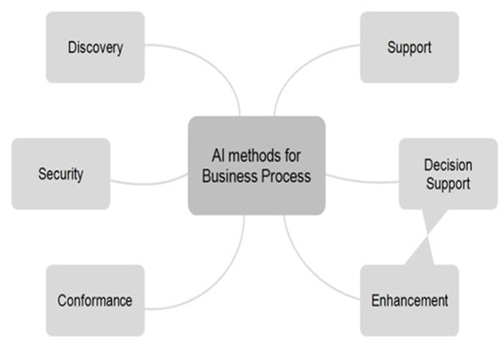
useful in business processes settings. Gomes et al. (2022) mention a thorough study of artificial
intelligence-related business processes, and methodologies of machine learning
algorithms, natural language processing, and expert systems are the most
important technologies in the BPM innovation Gomes et al. (2022).
|
Figure 1
|
|
Figure 1 Artificial
Intelligence-Based Methods |
Research shows
that organizations that apply machine learning algorithms in their BPM systems
realize a mean decrease in the process execution time by 34% and increased the
accuracy of decisions by 52%. In the meantime, organizations that utilize
natural language processing claim that processing a document is 67 times
quicker than when it is done manually. Applications of these methodologies
cross the various fields of process management in the lines of process
discovery, conformance checking, performance prediction, and decision support.
The tool approaches address specific complexities of the processes and machine
learning algorithms, particularly excelling at pattern recognition and
prediction modelling, but natural language processing enables human-system
interaction to be improved and document processing automated.
2)
Predictive
Business Process Management
One of the
greatest values of AI in BPM systems is predictive abilities. Abbasi et al. (2024) discuss the role of AI and machine learning
in predictive business process management and identify the techniques or
methods that could be used to predict future process behaviours, in terms of
process enhancement and improvement Abbasi et al. (2024).
The predictive
aspect of AI-enabled BPM allows an organization to shift out of reactive
problem-solving and into proactive process optimization. AI systems can be used
to derive insights based on analysing previous process data to indicate
bottlenecks, process resource needs, and areas of potential failure so that
organizations can act proactively instead of responding to events happening.
|
Figure 2
|
|
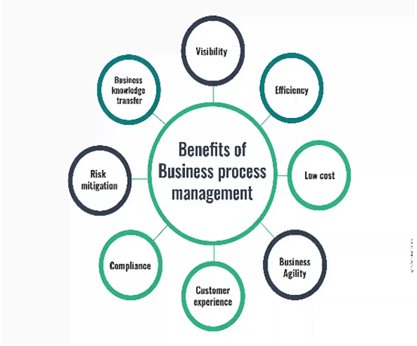
Figure 2 Business Process
Management Benefits Source:
https://www.mega.com/blog/what-is-business-process-management-bpm |
3)
Process
Automation and Emerging Technologies
The combination of
AI with BPM has been revolutionary in process automation. In the study by Oliveira et al. (2025) the use of BPM in conjunction with the
emergent technologies is discussed in regards to the process improvement of
both services and industrial processes based on systematic automation Oliveira et al. (2025).
Such automation
higher than basic automation of workflow and also to having some intelligence
in the decision-making process of the automatic systems. Automation systems
with the ability to respond to changing conditions, logically deal with
exceptions, and optimise process flows based on analysis of live data will be a
major improvement on the rigid automation systems presently used.
Framework for AI-Enhanced Decision Making
1)
Research
Approach
This thorough
paper is based on the broad literature research approach and examines
peer-reviewed articles, conference papers, and technical reports published
within the scope of 2022-2025. The paper is dedicated to the definition of the
trends, patterns, and empirical evidence related to the improvement of the
decision-making process with the help of AI in the BPM settings.
The research
methodology presupposes the use of both the quantitative and qualitative
analysis methods, but it evaluated case studies, implementation’s structure,
and performance measurements published in the literature. This will have a
wholesome insight into theory and its application to AI, as far as BPM is
concerned.
2)
Framework
for AI-Enhanced Decision Making
Resting on the
review of literature, it is possible to develop a conceptual model, that is,
describe how the AI enhances the use of decision-making in BPM in multiple
layers that are interdependent:
Cognitive
Layer: The bottom-level
deals with the integration of machine-learning algorithms, the principle of
natural language processing, and pattern-recognition skills to make the system
learn and comprehend the process of data.
Analytics
Layer: Additionally,
cognitive functions, this layer contains predictive and prescriptive analytics
to enhance complicated decision-making that forecasts the result of processes
and give the optimal line of action.
Integration
Layer: The layer offers an
easy introduction of the AI capabilities and the old BPM infrastructure without
affecting the consistency of the processes, but with additional opportunities
of facilitating decision-making.
Optimization
Layer: The final layer is
continuous improvement, by which AI insights can be applied to keep on
improving process designs, allocation of resources, and performance metrics.
Key Findings and Analysis
1)
Value
Creation Through BPM-AI Integration
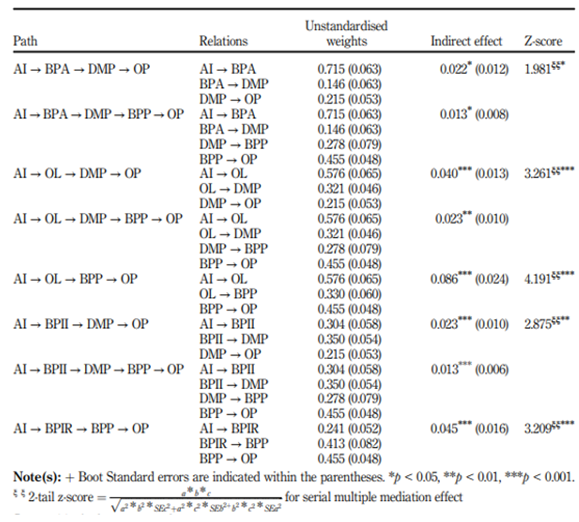
The research by Zebec and Indihar Stemberger (2023) highlights
that the process of constructing AI business value, of BPM capabilities, should
be comprehensive that the technological capabilities should be interconnected
with organizational goals Zebec and Indihar Štemberger (2024). Their findings reveal that the AI-based
integration of BPM ensures the quantitatively effective growth in the
efficiency, decision accuracy, and enhancement of agility on the organizational
level. The study discovered that organizations that had successfully integrated
AI-BPM claimed 41 percent decrease in operational efficiency and 29 percent
decrease in decision making time and almost 85 percent of the executives
indicated an increase in strategic agility.
|
Figure 3
|
|
Figure 3 Results of the
Serial Multiple-Mediation Analysis Source: Zebec and Indihar Stemberger (2023) |
Value creation
process entails a number of key considerations, including: the preparation
level of an organization to adopt AI, the technical hurdles capability of the
organization to accommodate, and the match of AI capabilities with targeted
business processes requirements. Companies that are successful at the
integration level also tend to be more mature and technologically advanced in
processes.
2)
Next-Generation
BPM Systems
Hildebrand et al. (2024) give a hint on the future of BPM systems due
to the fact that they review systematic literature on cognitive computing
enhancement in BPM Hildebrand et al. (2024). Based on their investigation, cognitive BPM
systems have been shown to perform better when dealing with complex,
non-routine decisions that need an understanding of the contexts and flexible
responses.
|
Figure 4
|
|
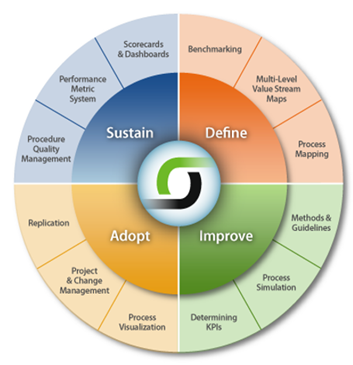
Figure 4 Business Process
Management Source: http://www.colombus.com/business-process-management.html |
The new advanced
AI technologies that are featured in these next-generation systems made the
decision-making process more sophisticated, in terms of deep and, reinforcement
learning, and cognitive computing architectures. The systems can cope with
ambiguous incidents, learn by experience, and model their decision-making
processes in response to changing environmental settings.
3)
AI-Enhanced
Business Intelligence
It has been
observed that the combination of AI and business intelligence systems,
particularly in decision awareness in complex processes, has been an effective
strategy. Siddiqui (2025) discusses how BI systems combining AI can be
used to optimise business decisions with systematic, data-driven insights
within business, financial, and strategic planning Siddiqui (2025).
These systems also
provide an advanced analytics capability to decision-makers, more than
reporting to providing predictive modeling, scenario analysis, and a
recommendation system. The AI-based approach is able to make more efficient
decisions, as it is based on the possibility to withstand more available
information and locate the patterns that would barely become visible to the
members of the human team.
4)
Knowledge
Management Integration
Another valuable
AI-enabled decision-making development is the combination of BPM and knowledge
management systems. To investigate this integration, Berniak-Woźny and Szelągowski (2024) refer to the fact that the situation where
knowledge management enhances the context of decision-making in the BPM systems
is mentioned Berniak-Woźny and Szelągowski (2024).
This combination
may cause exploitation of institutional knowledge, best practices and expertise
by organizations in the decision-making process. The AI systems can access the
organizational knowledge that can be utilized in the process of making decisions
that are more informed and contribute new knowledge based on the experiences
and results of the process.
Implementation Challenges and Considerations
1)
Technical
Integration Challenges
There are a few
technical issues to be faced during the implementation of AI-enhanced BPM
systems owned by an organization. According to Bharadiya (2023), the main challenges comprise the complexity
of the system integration, the levels of the required data quality, and the
specialized technical expertise that would be required Bharadiya (2023). Survey data reveals that 68% of
organizations struggle with data quality issues during AI-BPM implementation,
while 72% report difficulties in finding skilled technical personnel. About 45%
of projects experience delays due to integration complexities.
Technical
integration must be carefully considered and should be based on the existing
architectures, data formats and processing specifications. In addition to that,
organizations must ensure that AI elements can effectively interface with the
existing BPM system without compromising system performance or reliability.
2)
Organizational
Change Management
The technical
consideration will not be sufficient to integrate AI successfully into BPM as
it will entail a comprehensive organization change management. The codified
rule-based strategy that involves migration of programs to the faster
artificial intelligence systems can potentially require radical business,
corporation, training, and practice processes Huy and Phuc (2025).
Change management
should also look at managing employee apprehension of adopting AI, and ensure
training and development are availed as well as infrastructural changes to
accommodate the new AI-empowered operations. In some cases, the human element
is as important as the technical one in implementation.
3)
Process
Mining and AI Integration
There exist both
opportunities and challenges in combining the techniques of process mining with
the capabilities of AI. Chaima and Khebızı (2022) present an outline on how to exploit
business process models in mining using artificial intelligence methods and how
AI can be used to improve process discovery and its analysis Chaima and Khebızı (2022).
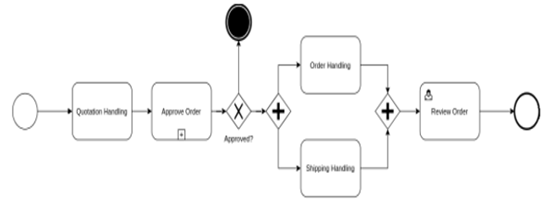
|
Figure 5 |
|
Figure 5 BPMN of Online
Order Management Application’s Source:
Chaima
and Khebızı (2022) |
AI-integrated
process mining techniques allow organizations to automatically identify process
patterns, find areas of potential improvement, and identify process deviations.
These capabilities are, however, only implemented with the advanced data
processing infrastructure and expertise in the analytical field.
Emerging Technologies and Future Directions
1)
Generative
AI in BPM
The latest
advances in generative AI have presented the opportunity to improve BPMs.
ProcessGPT and other AI-based business process management generators are
discussed in the article by Beheshti et al. (2023) as an example of how the evolution of
business processes can be significantly changed due to the introduction of
natural language interfaces and automatic creation of complex business
processes Beheshti et al. (2023).
Generative AI
technologies are more natural and offer the human-system interaction; BPM
systems can be addressed in natural language by process designers and
participants. This is a major feature that reduces the technical edifice to BPM
system utilization and enables the organization to patronize the entity more.
2)
Dynamic
Decision-Making Capabilities
It is an enormous
move towards AI-based BPM with the development of dynamic decision-making
capabilities. Huy and Phuc (2025) discuss the contribution of the BPM
capabilities to the enrichment of the dynamic decision-making to the effective
and sustainable digital transformation Huy and Phuc (2025).
Dynamic
decision-making systems are able to update the decision criteria given the
changing environmental conditions through learning the past decision outcomes.
This is significant in a fast moving corporate world where set rules of
business decision making are rendered extinct in quick succession.
3)
AI-Augmented
BPM Systems
The research of
AI-enhanced business process management solutions offered by Dumas et al. (2023) includes a map of the future research
directions and implementation significances Dumas et al. (2023). The analysis gives the areas of the
research as intelligent process discovery, adaptive process execution and
cognitive process monitoring.
Implications and Recommendations
1)
Strategic
Implications
The AI in BPM will
have critical business strategy employment. AI-enhanced BPM systems are
extremely advantageous to companies capable of implementing them since they are
known to increase the rate and accuracy of a decision, in addition to
conferring consistency in the decisions. Achieving AI-enhanced BPM will need
the commitment of an executive to allocate the appropriate resources and have a
vision on how it fits organizational goals. Organizations are to build holistic
AI plans that take into account BPM considerations as part of the larger plan
rather than distinct projects.
2)
Implementation
Recommendations
Based on the
systematic study, it is possible to make several recommendations to
organizations aiming to improve their decision-making process with the help of
AI-based BPM:
Gradual Integration Approach: Organizations should adopt a phased implementation approach, beginning with pilot projects in specific process areas before expanding to enterprise-wide deployment.
Investment in Data Quality: High-quality data is needed to implement AI successfully. The organizations need to invest in data governance, cleansing, and management competencies to facilitate AI-enhanced decision-making.
Skill Development: The organisational seeks to learn how to use technical capabilities of AI and how to run a process. This often needs specifically-developed training programs and recruitment.
Change Management: An sufficient change management should also be consider in effecting the adoption of the AI-enhanced processes in the company.
3)
Future
Research Directions
Certain directions
are also few and should be where the further research should be directed.
Further development of AI-BPM integration systems, which are specific to
industries, would offer more specific advice. Better to the point, the aspect
of the AI decision-making business use, in its turn, regarding the ethical
consideration, should be investigated, of course, within the frames of
transparency and accountability.
More sophisticated
measures should be anchored on the success of the AI-BPM integration that would
measure the outcome of performance and qualitative measures which would touch
on the organizational agility and quality decision making processes. Moreira et al. (2024) state the significance of systematic
approach in small and medium business, which proves that, the need to work out
the scalable approach implementation methodology that must be applied in the
organizations of other sizes and maturity levels Moreira et al. (2024).
Conclusion
The
transformational prospect of the hybridization of Artificial Intelligence (AI)
on Business Process Management (BPM) is illuminated in this review paper to
revitalize the intricate process of making decision in companies. Time after
time, research indicates that AI optimized BPM strategies are more accurate in
their decision-making, faster and adaptable as compared to traditional
strategies. Among the significant success factors recognized, there are
organizational preparedness, technical infrastructure, information quality and
change management. Generative AI and cognitive computing are the
next-generation technologies that will take the BPM decision-making to the next
level as it can understand the nature of significantly more complex problems
and provide a more sophisticated human-machine interaction. The fusion of AI
and BPM presupposes responding to technical, organizational, even establishment
of the required competencies in order to attain them since the general change
is obligatory. Measurements of the success, ethical considerations, and
industry-specific frameworks are some of the problems which the future
researchers are to consider. Finally, the AI-based BPM systems will turn out to
be the new era of the management of processes within the organisations to allow
organisations to respond to the dynamic environments.
ACKNOWLEDGMENTS
None.
REFERENCES
Abbasi, M., Nishat, R. I., Bond, C., Graham-Knight, J. B., Lasserre, P., Lucet, Y., and Najjaran, H. (2024). A Review of AI and Machine Learning Contribution in Predictive Business Process Management (Process Enhancement and Process Improvement Approaches). arXiv Preprint. https://doi.org/10.1108/BPMJ-07-2024-0555
Beheshti, A., Yang, J., Sheng, Q. Z., Benatallah, B., Casati, F., Dustdar, S., Nezhad, H. R. M., Zhang, X., and Xue, S. (2023). ProcessGPT: Transforming Business Process Management with Generative Artificial Intelligence. In Proceedings of the 2023 IEEE International Conference on Web Services (ICWS) (731–739). IEEE. https://doi.org/10.1109/ICWS60048.2023.00099
Berniak-Woźny, J., and Szelągowski, M. (2024). A Comprehensive Bibliometric Analysis of Business Process Management and Knowledge Management Integration: Bridging the Scholarly Gap. Information, 15(8), 436. https://doi.org/10.3390/info15080436
Bharadiya, J. (2023). The Impact of Artificial Intelligence on Business Processes. European Journal of Technology, 7(2), 15–25. https://doi.org/10.47672/ejt.1488
Chaima, A., and Khebızı, A. (2022). A Road-Map for Mining Business Process Models via Artificial Intelligence Techniques. International Journal of Informatics and Applied Mathematics, 5(1), 27–51. https://doi.org/10.53508/ijiam.1036234
Dumas, M., Fournier, F., Limonad, L., Marrella, A., Montali, M., Rehse, J. R., Accorsi, R., Calvanese, D., De Giacomo, G., Fahland, D., and Gal, A. (2023). AI-Augmented Business Process Management Systems: A Research Manifesto. ACM Transactions on Management Information Systems, 14(1), 1–19. https://doi.org/10.1145/3576047
Gomes, P., Verçosa, L., Melo, F., Silva, V., Filho, C. B., and Bezerra, B. (2022). Artificial Intelligence-Based Methods for Business Processes: A Systematic Literature Review. Applied Sciences, 12(5), 2314. https://doi.org/10.3390/app12052314
Hildebrand, D., Rösl, S., Auer, T., and Schieder, C. (2024). Next-Generation Business Process Management (BPM): A Systematic Literature Review of Cognitive Computing and Improvements in BPM. In International Conference on Subject-Oriented Business Process Management (262–278). Springer. https://doi.org/10.1007/978-3-031-72041-3_18
Huy, P. Q., and Phuc, V. K. (2025). Unveiling How Business Process Management Capabilities Foster Dynamic Decision-Making for Effectiveness of Sustainable Digital Transformation. Business Process Management Journal, 31(8), 67–103. https://doi.org/10.1108/BPMJ-06-2024-0467
Kokala, A. (2024). Harnessing AI for BPM: Streamlining Complex Workflows and Enhancing Efficiency. Authorea Preprints. https://doi.org/10.36227/techrxiv.173532331.17776706/v1
Moreira, S., Mamede, H.
S., and Santos, A. (2024). Business Process Automation in SMEs: A Systematic Literature Review.
IEEE Access, 12, 75832–75864. https://doi.org/10.1109/ACCESS.2024.3406548
Oliveira, A., Silva, A., Camara, D., Silva, E., and Santiago, L. (2025). Process Automation with BPM and Emerging Technologies for Service and Industrial Process Optimization: Systematic Mapping. In Proceedings of the Simpósio Brasileiro de Sistemas de Informação (SBSI) (85–94). https://doi.org/10.5753/sbsi.2025.246014
Siddiqui, N. A. (2025). Optimizing Business Decision-Making Through AI-Enhanced Business Intelligence Systems: A Systematic Review of Data-Driven Insights in Financial and Strategic Planning. Strategic Data Management and Innovation, 2(1), 202–223. https://doi.org/10.71292/sdmi.v2i01.21
Zebec, A., and Indihar Štemberger, M. (2024). Creating AI Business Value Through BPM Capabilities. Business Process Management Journal, 30(8), 1–26. https://doi.org/10.1108/BPMJ-07-2023-0566
|
|
 This work is licensed under a: Creative Commons Attribution 4.0 International License
© ShodhAI 2026. All Rights Reserved.